Skip to content
Felipe Linares Mendoza Master cartonero · Mexico City
Palette

A living tradition

The Linares legacy

An illness around 1936, a dream and five generations of cartoneros.

Five generations of cartoneros in Mexico City. A dream during Pedro Linares’s illness. A son, Felipe, who carried the creatures to sculpture. And a word, “alebrije”, that today names an emblem of the city.

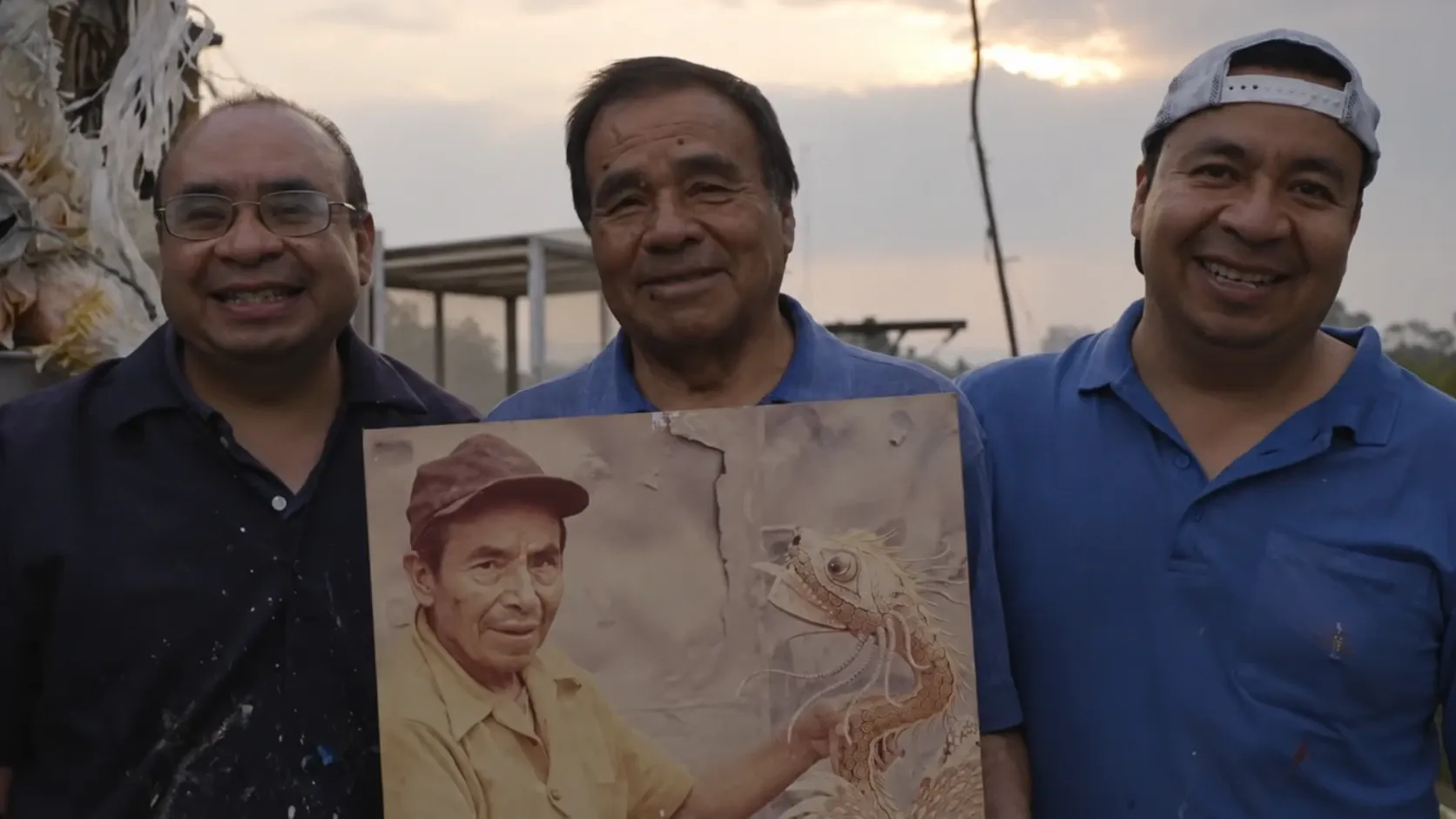
Three men smile at dusk outside the workshop: on the left Leonardo Linares Vargas with glasses, in the centre Felipe Linares Mendoza and on the right Felipe Linares Vargas in a cap; they hold a sepia portrait of Pedro Linares López with an alebrije.
Left to right: Leonardo Linares Vargas, Felipe Linares Mendoza and Felipe Linares Vargas, with a portrait of Pedro Linares López · photograph provided by the family.

Before the dream

Cartonería is an old craft in Mexico City. Cartoneros worked to the rhythm of the festive calendar —Judas figures for Holy Week, skeletons for the Day of the Dead, piñatas for Christmas— and the Linares family practiced it before Pedro Linares López: his father, José Dolores, and his grandfather, Celso, worked cardboard, and Don Pedro said his father taught him and his brother.

Pedro Linares’s dream

Around 1936, at thirty, Pedro Linares López fell seriously ill. The family says he was in a coma and that in his delirium he saw creatures combining parts of different animals and shouting one word, “alebrijes”. On recovering he began to model them in paper and cardboard. The sources do not agree on the year: according to the family, the first alebrijes appeared around 1947–1948, and this site fixes no single date.

Painters, documentaries and a national prize

The family remembers that Diego Rivera bought the first pieces and commissioned figures. In 1975 Judith Bronowski’s documentary “Pedro Linares: Artesano Cartonero” recorded the workshop and brought the family’s work to an international audience. In 1990 Don Pedro received the National Prize for Arts and Sciences in Popular Arts and Traditions; he died in January 1992.

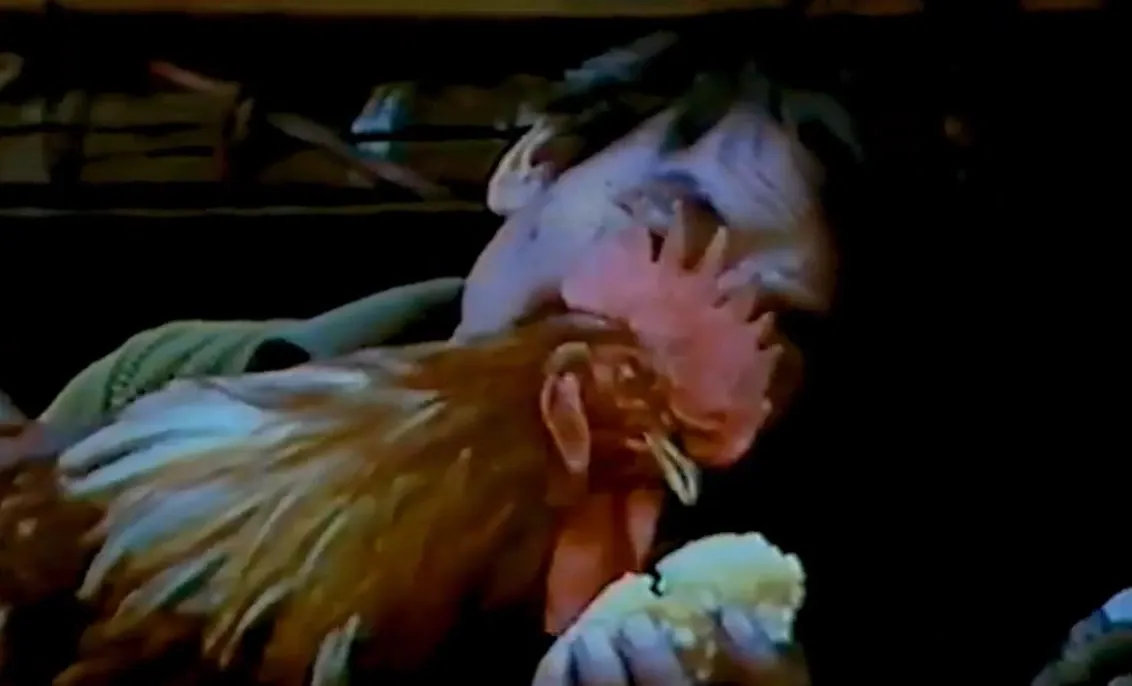
1975 still: Pedro Linares López, in profile, holds Barbas, a reddish rooster, against his chest in a dim interior.
Pedro Linares López with the rooster Barbas · identification confirmed by the family · Still from “Pedro Linares: Artesano Cartonero”, Judith Bronowski, 1975, c. 14:20
  • c. 1936Pedro Linares López falls ill and dreams of the alebrijes; according to the family, the first ones appear around 1947–1948.
  • 1990National Prize for Arts and Sciences, Popular Arts and Traditions.
  • 2019Alebrijes declared cultural heritage of Mexico City.
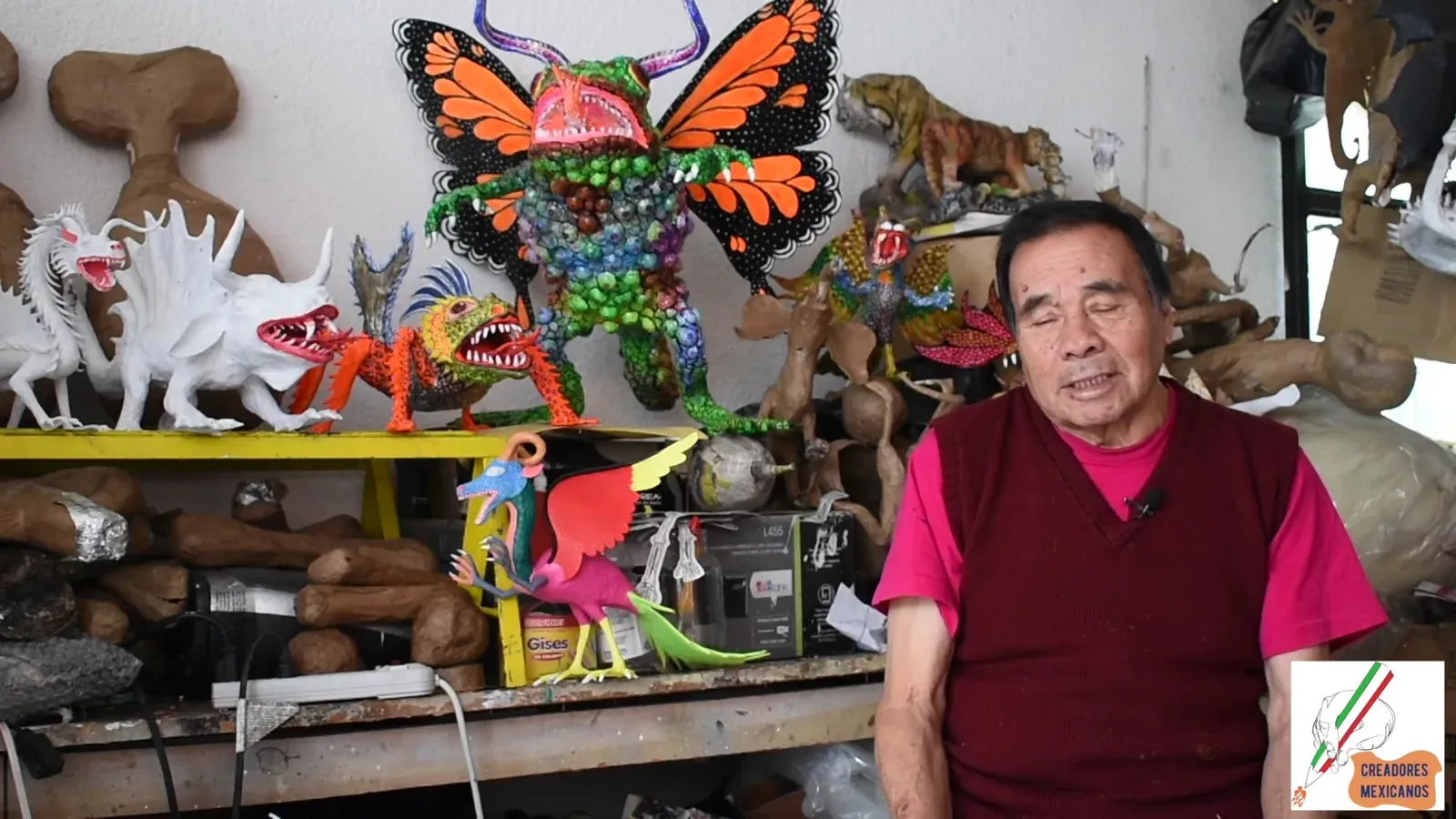
Felipe Linares Mendoza beside several finished, brightly colored alebrijes.
Felipe Linares Mendoza with finished alebrijes (name card “Felipe Linares” on screen) · Still from “#CreadoresMexicanos: Familia Linares”, El Tizoncito, 00:20

Felipe Linares Mendoza, the son who carried the craft to sculpture

Felipe Linares Mendoza, born in 1936, began working paper at about ten and, as he tells it, has worked the paper craft since 1947. He added horns, scales, feathers and crests to the alebrijes; he polished the pieces like sculptures and painted with a detail his sons still admire. In 1984 and 1985 his Posada skeletons were shown in Mexico City and New York; in 1986 he made the earthquake scene for the Day of the Dead; in 1989 he was at the Centre Pompidou with two of his sons. His work is in the Museo Nacional de Culturas Populares, the Brooklyn Museum and the Fowler Museum. His brothers Enrique and Miguel also followed the craft; Miguel exhibited with his father and his son Ricardo in California in 1991.

The grandsons, each in his own workshop

Leonardo, Felipe and David Linares Vargas, sons of Felipe Linares Mendoza, and Ricardo Linares García work in independent workshops. Leonardo announced in 2019 the declaration of alebrijes as heritage of the city and received the 2026 Artisanal Career Award; Felipe has “Tzompantli” (2010) in the Museo Nacional de Culturas Populares and a rooster alebrije in the Museum of International Folk Art’s traveling exhibition (2026–2028); David has “Mujer con niño” (1992) in the same museum. One more generation —Gerardo Linares Gómez, Don Pedro’s great-grandson— already takes part in public events.

The alebrije as heritage

Since 2007 the Museo de Arte Popular has held a parade of monumental alebrijes along Paseo de la Reforma every October. In October 2019 the Government of Mexico City declared alebrijes cultural heritage of the city; the decree was published in the Official Gazette on December 30 of that year. Museums such as the Fowler Museum (UCLA), the Museo Nacional de Culturas Populares, the Brooklyn Museum and the Museum of International Folk Art hold or have exhibited the family’s work.

The story as told by the family

From a dream an impossible world was born

The Linares family tells that it all began when Don Pedro was seriously ill. An ulcer put him in bed and, as the family remembers it, even into a coma. Between dreams and delirium he saw extraordinary creatures, beings that seemed to combine parts of different animals, figures as unsettling as they were fascinating, shouting over and over an unknown word: alebrijes!

His son Felipe remembers the first figure he made on recovering: “a strange thing”, with a monkey’s face, painted in dark colors so it would look as ugly as he had seen it. With paper, cardboard, paste and his imagination, those creatures began to exist outside his dreams. Over time he settled what an alebrije is: a fantastic figure that combines parts of several different animals.

“A donkey with wings, well, there is no such thing, but you imagine that it could be an alebrije.”

Pedro Linares López, in the 1975 documentary (translated)

Here the only thing forbidden was to forbid

In the Linares workshop the craft did not begin with lessons or instructions. It began with play. The children watched their father and grandfather work; they took newspaper, prepared paste and tried to reproduce the figures they saw appearing between their hands. There was no written method: you learned by watching, trying, failing and starting again.

“Here the only thing forbidden was to forbid.”

Leonardo Linares Vargas, video testimony (family archive; translated)

That freedom was also a form of teaching. Each generation discovered, in its own time, how to turn everyday materials into creatures that existed nowhere else.

The son who learned by watching

Felipe Linares Mendoza, Don Pedro’s son, says he began working paper at about ten, watching his father, and that to him “it felt like a game”. When the alebrijes arrived in the workshop, he decided to add more to them: horns, scales, whatever came to mind. His first alebrije was a figure with an armadillo body, a rooster head and a skull mounted on top.

“I watched what my father did and always tried to do it better.”

Felipe Linares Mendoza, video testimony (family archive; translated)

Over the years, he recalls, he was invited to give a cartonería workshop in San Antonio, Texas, and later gave demonstrations in Los Angeles, Sacramento, San Jose and Finland. His greatest satisfaction, he says, is having made the family’s work known in places very far away.

The craft handed down through the hands

Felipe Linares Vargas remembers the afternoons after secondary school, when he would arrive at the workshop and sit beside his father. Between conversation, paper and paint, he was given small tasks: whitening a figure, decorating a piece, watching how a detail was resolved. Over the years those afternoons ended up defining his path. Although he studied programming, he found that his place was in the workshop.

“I was more drawn to being here with my father because here I expressed my creativity.”

Felipe Linares Vargas, video testimony (family archive; translated)

Knowledge was not passed on in words alone. It lived in the way the hand moved, in the patience to build a figure and in the care with which each brushstroke was applied. Leonardo says it of his father: from him he learned “fine work”, and he is still amazed by the skill with which he paints.

A tradition that keeps imagining

The essential materials remain: newspaper, manila paper, tissue paper, kraft paper, paste, wire or reed. In Leonardo’s workshop, nothing that is not paper: no polystyrene, no plastics, no fabrics, no glass eyes. But the possibilities keep growing. In the hands of Felipe Linares Mendoza and his sons, the alebrijes take on new forms, movements, heights, textures and details. Each piece keeps the knowledge of those who came before, but also expresses the imagination of its maker.

“To make an alebrije there is no mold, there is nothing. It is raised with paper, pure paper.”

Felipe Linares Mendoza, in the video “Soy creador mexicano” (family archive; translated)

It is not about repeating exactly the figures of the past. It is about keeping the craft alive, experimenting with its possibilities and finding new ways to bring the impossible to life. Because in the Linares family tradition is not a form that must stay still: it is an art that keeps transforming itself, generation after generation.
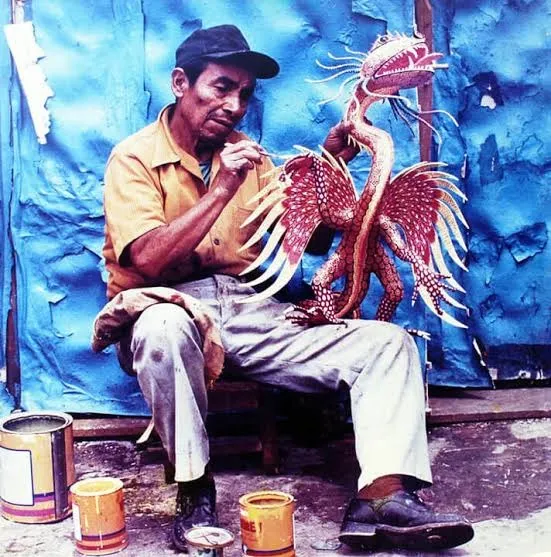
Old photograph: Pedro Linares López, in a cap and yellow shirt, seated before a blue wall, painting a red winged, crested alebrije with a brush; paint cans on the floor.
Pedro Linares López painting an alebrije · archival photograph, author and date to be confirmed.
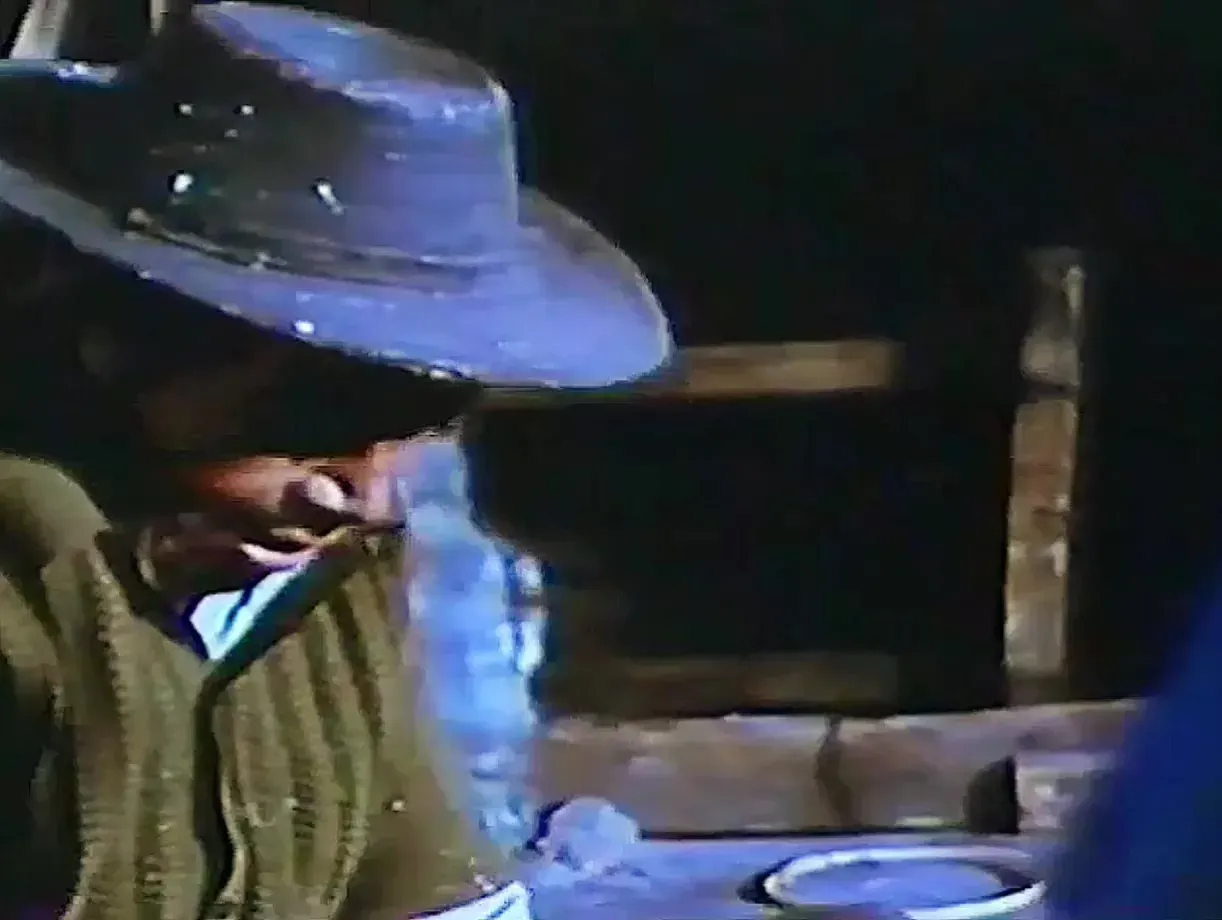
A man in a hat works the reed armature of a Judas figure in the workshop, in 1975.
Pedro Linares López working the reed of a Judas figure, 1975 (identified by the Capital 21 program; to be confirmed with the family) · Still from “Pedro Linares: Artesano Cartonero”, Judith Bronowski, 1975, 16:30
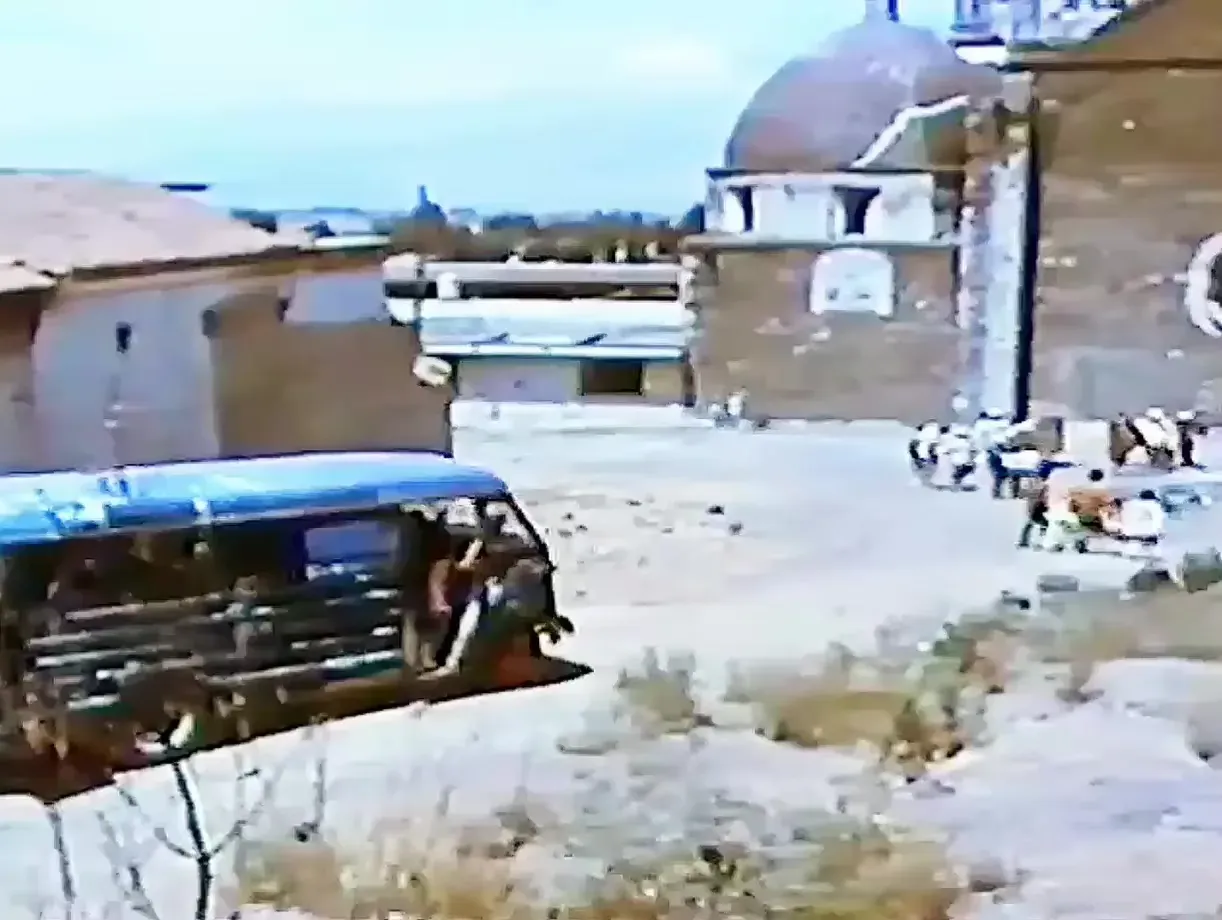
A cartonería Judas figure in front of the church, before the burning, in 1975.
A Judas figure in front of the church, before the burning · Still from “Pedro Linares: Artesano Cartonero”, Judith Bronowski, 1975, 19:00
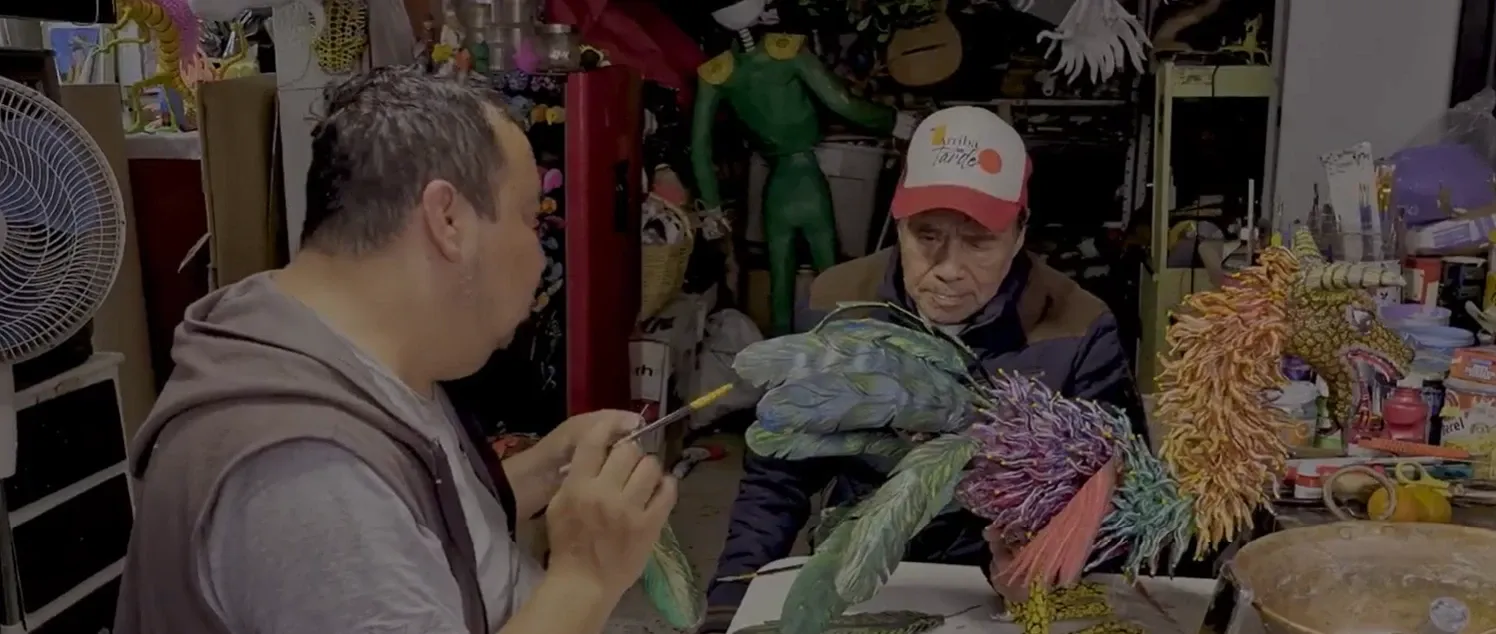
Felipe Linares Vargas paints a green-and-blue feathered alebrije at the workshop table; across from him, his father Felipe Linares Mendoza, in a cap, watches the piece.
Felipe Linares Vargas and his father, Felipe Linares Mendoza, at the workshop table · still provided by the family.
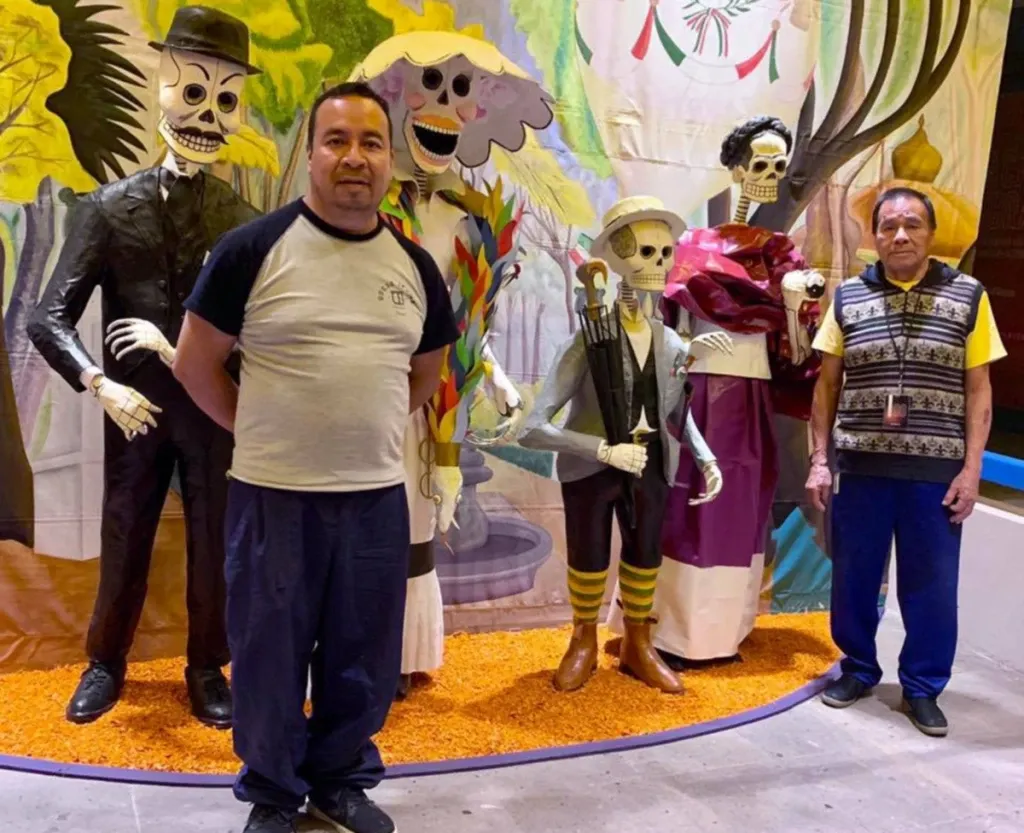
Felipe Linares Vargas and Felipe Linares Mendoza standing before four life-size cartonería skeletons dressed as catrines and catrinas, on a bed of marigold petals in front of a painted backdrop.
Felipe Linares Vargas and Felipe Linares Mendoza with life-size skeletons · place, date and makers of the pieces to be confirmed.
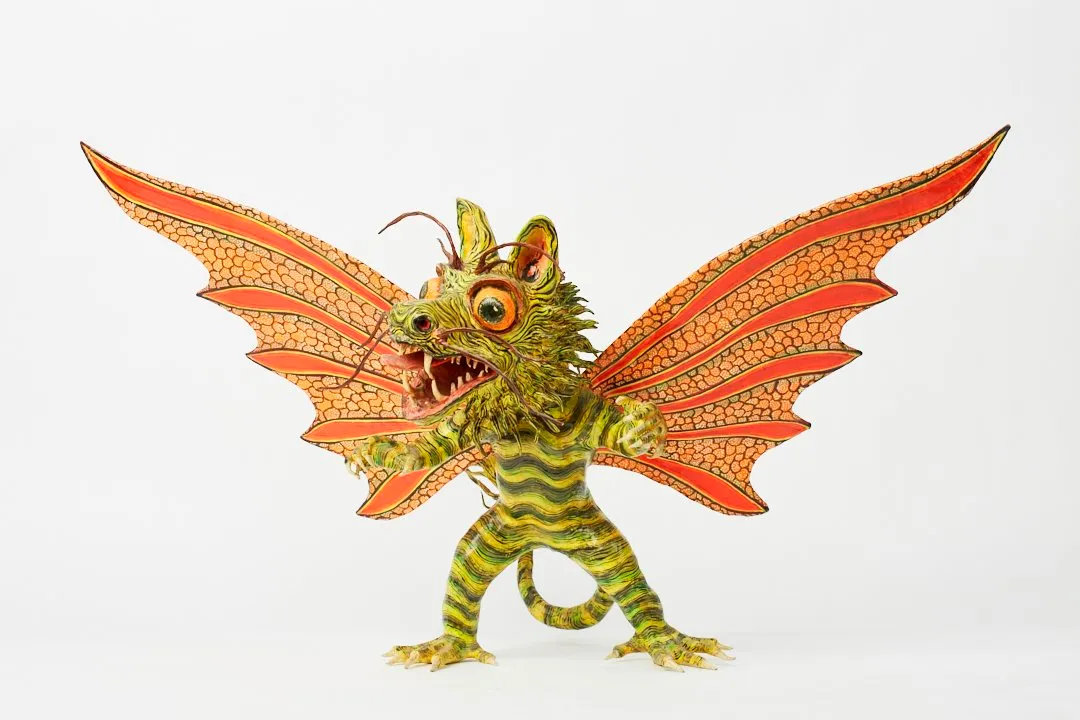
Cartonería alebrije with a green-and-yellow striped body, open orange-and-red wings with a stone texture, and a fanged feline face.
Striped alebrije with orange wings · family-workshop piece, maker to be identified.
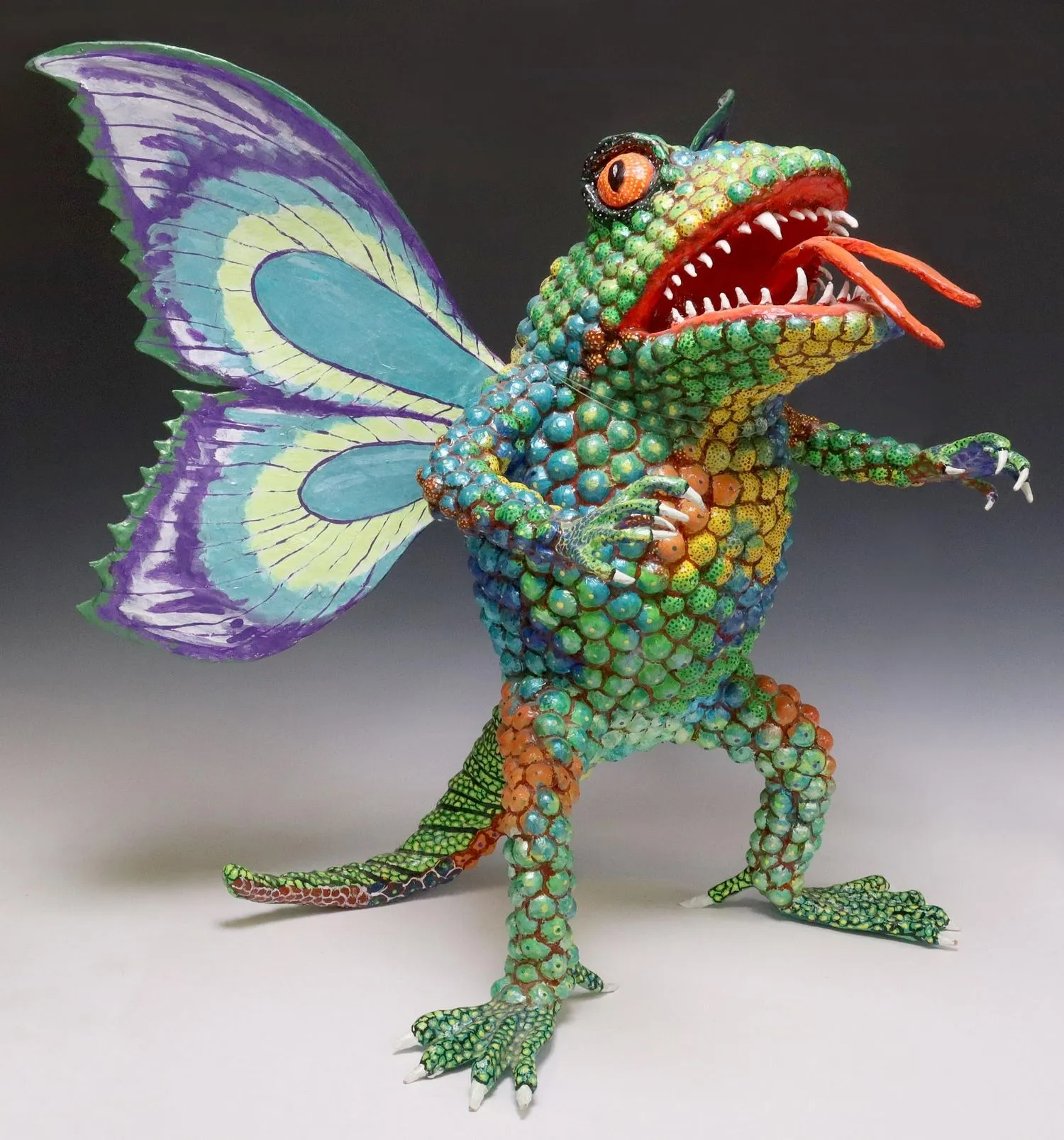
Alebrije with a frog body covered in green, blue and orange scales, purple-and-blue butterfly wings, open mouth with fangs and a red tongue.
Frog alebrije with butterfly wings · family-workshop piece, maker to be identified.

The alebrije lineage

From the creator to the master, and from the master to his sons

Pedro Linares López created the alebrijes. His son Felipe Linares Mendoza carried them to sculpture and taught them to his sons, who work today in independent workshops.

Family tree

Five generations

Select a family member to read their profile.

Ancestors

Pedro Linares López

The sons

The grandchildren

The great-grandchildren

Timeline

From 1906 to today

  1. 1906
    Linares family

    Pedro Linares López is born in Mexico City (June 29).

  2. 1936
  3. 1936
  4. 1952
  5. 1968
  6. 1972
  7. 1973
  8. 1975
  9. 1978
  10. 1984
  11. 1985
  12. 1986
  13. 1986
  14. 1989
  15. 1989
  16. 1989
  17. 1990
  18. 1991
  19. 1991–1992
  20. 1992
    Linares family

    Pedro Linares López dies in January; his sons and grandsons continue the craft.

  21. 1992
  22. 1993
  23. 1994–1995
  24. 2000
  25. 2003
  26. 2005
  27. 2007
  28. 2010
  29. 2011–2012
  30. 2013
  31. 2014
  32. 2016
  33. 2019
  34. 2020
  35. 2021
  36. 2022–2025
  37. 2023
  38. 2023
  39. 2025
  40. 2025–2026
  41. 2026
  42. 2026–2028
  43. 2026
  44. 2026

The alebrije belongs to cartonería

The alebrije was born in Mexico City, in the workshop of Pedro Linares López, after the illness Don Pedro suffered around 1936; the family places the first pieces around 1947–1948. It is built with paper, cardboard and paste over a light frame, modeled by hand and painted with a brush. It is a hollow, light piece that can reach a large scale, and it belongs to the urban tradition of cartonería: that of the Judas figures, the skeletons and the piñatas.

The name, the concept and the technique —the dream, the paper and the cardboard— belong to Mexico City and the Linares family; Oaxaca’s wood carvings took the name after the carver Manuel Jiménez met Pedro Linares in 1978, as both families tell it. The Government of Mexico City recognized as much when it declared alebrijes cultural heritage of the city in 2019. This page documents that history with verifiable sources; what is not documented is marked as family recollection or as pending confirmation.

  • MaterialPaper, cardboard and paste over a light armature
  • FormModeled by hand; hollow, light piece
  • PaintBy brush: spots, scales, veins and dots
  • OriginPedro Linares López, Mexico City; first alebrijes around 1947–1948 according to the family
  • HeritageCultural heritage of Mexico City since 2019

Sources and references

  1. Linares family (alebrijes and cartonería), Wikipedia
  2. Magia en papel y cartón (interview with Leonardo Linares Vargas), Siempre! (2020-03)
  3. Histórico de galardonados, Premio Nacional de Ciencias y Artes (entry 156: 1990, Pedro Linares López), Universidad Veracruzana
  4. Living Traditions: Mexican Popular Arts (essay by Annie O’Neill, 1992), University at Albany Art Museum
  5. Magia en papel y cartón, Siempre! (2020-03-14)
  6. El Museo Nacional de Culturas Populares rinde homenaje a Pedro Linares, creador de los alebrijes, por su 119 aniversario, Secretaría de Cultura (2025-06-25)
  7. Pedro Linares López’s 115th Birthday, Google Doodles (2021-06-29)
  8. Video testimonies of Pedro Linares López, Felipe Linares Mendoza, Felipe Linares Vargas and Leonardo Linares Vargas (family archive), Family archive (2026)
  9. Linares, Pedro (1906–1992), Encyclopedia.com
  10. Alebrije (1993) — Felipe Linares Mendoza, record MX-SC-MNCP-001501_A, Museo Nacional de Culturas Populares
  11. Winged Dragon (Alebrije), Felipe Linares (born 1936), 2003.29, Brooklyn Museum
  12. Figure (alebrije), Felipe Linares (b. 1936), X91.240A-D, Fowler Museum at UCLA
  13. Magiciens de la Terre (1989), list of artists, Centre Pompidou, Catalogue des expositions
  14. Cartonería — Panorámica de arte popular, Sistema de Información Cultural, Secretaría de Cultura
  15. Of Corpse: Death and Humor in Folklore and Popular Culture (notes 15 and 16 of Kristin Congdon’s chapter), Utah State University Press / Library of Congress (2003)
  16. Leonardo Linares, heredero de la tradición cartonera para la quema de los judas, La Jornada (2026-04-04)
  17. El mundo de papel de la familia Linares, Radio Educación (1989-10-24)
  18. Calaveras — Felipe Linares, Asociación de Amigos del MAP / Google Arts & Culture
  19. Video testimonies of Felipe Linares Mendoza, Felipe Linares Vargas and Leonardo Linares Vargas (family archive), Family archive (2026)
  20. Los alebrijes: la artesanía mexicana de cartón que nació por un sueño en un barrio de la Ciudad de México, CNN en Español (2024-10-21)
  21. Alebrije, Wikipedia
  22. Tzompantli – Felipe Linares Vargas (object record), Museo Nacional de Culturas Populares / Google Arts & Culture
  23. New exhibit showcases fantastical creatures in Mexican folk art, KUNM (2026-05-04)
  24. Niño con calaverita (1992) — Leonardo Linares Vargas, record MX-SC-MNCP-001943, Museo Nacional de Culturas Populares
  25. Sinful Saints and Saintly Sinners at the Margins of the Americas, Fowler Museum at UCLA (2014)
  26. Of Corpse: Death and Humor in Folklore and Popular Culture (note 15 of Kristin Congdon’s chapter), Utah State University Press / Library of Congress (2003)
  27. Reconocen el arte popular; gana creadora guerrerense, Zócalo / Agencia Reforma (2026-10-16)
  28. Alebrijes, patrimonio cultural de la CDMX; en exhibición hasta el 17 de noviembre, Excélsior (2019-10-20)
  29. Video testimonies of Leonardo Linares Vargas (Capital 21 and family interviews; family archive), Family archive (2026)
  30. Ricardo Linares García, International Folk Art Market